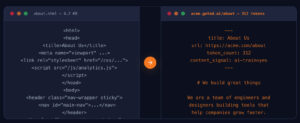
Every page on your website is written in HTML. That’s fine for browsers – they know how to turn <div class="hero-section"> and <nav aria-label="main-navigation"> into the visual layout your visitors see. But AI systems aren’t browsers. They don’t render pages. They read text. And HTML is a spectacularly inefficient way to deliver text.
Understanding why markdown matters is the foundation of making your website visible to AI systems like ChatGPT, Perplexity, Claude, and Google AI Overviews. If you take away one thing from this article, let it be this: the format you serve your content in directly affects whether AI systems can use it – and whether they’ll bother trying.
What is markdown?
Markdown is a lightweight text formatting language created by John Gruber in 2004. It was designed to be readable by humans in its raw form while also being easy to convert into HTML for the web.
Where HTML wraps content in tags:
<h2>Our Services</h2>
<p>We provide <strong>three core services</strong> for enterprise clients:</p>
<ul>
  <li>CRM implementation</li>
  <li>Revenue operations</li>
  <li>Digital transformation</li>
</ul>
Markdown expresses the same content with minimal syntax:
## Our Services

We provide **three core services** for enterprise clients:

- CRM implementation
- Revenue operations
- Digital transformation
Both produce the same rendered output. But the markdown version is shorter, cleaner, and – critically – contains almost nothing that isn’t actual content.
That last point is what makes markdown the gold standard for AI systems.
The 80% waste problem
Here’s a number that should concern anyone thinking about AI visibility: on a typical web page, roughly 80% of the tokens are not your content.
Let’s break that down. When an AI system fetches a web page, it receives the full HTML source. That includes:
- The
<head>section: meta tags, Open Graph tags, schema markup, CSS links, JavaScript bundles, analytics snippets, font declarations - Navigation: header menus, mega menus, breadcrumbs, sidebar navigation, footer links
- Scripts: tracking pixels, chat widgets, cookie consent managers, A/B testing tools, heatmap trackers
- Layout markup: wrapper divs, grid containers, responsive breakpoints, ARIA attributes, class names
- Repeated elements: headers and footers appear on every page but aren’t the content
A page that displays 800 words of readable content to a human visitor might arrive as 16,000+ tokens of HTML to an AI system. The actual content – the 800 words your visitor came for – accounts for roughly 3,000 tokens.
The remaining 13,000 tokens are noise. Not useless for a browser – but completely useless for an AI system trying to extract information.
Why this matters for AI visibility
AI systems have finite context windows. Every model – GPT-4, Claude, Gemini, Llama – can only process a certain number of tokens in a single interaction. When a user asks a question and the AI system needs to retrieve information from the web, every token it spends on navigation menus and tracking scripts is a token it can’t spend on actual content.
This creates three practical problems:
Retrieval efficiency. When an AI system is evaluating multiple sources to answer a question, it can process more clean markdown pages than bloated HTML pages in the same token budget. Sites that serve clean content get more of their pages considered.
Extraction accuracy. Buried in 16,000 tokens of HTML, the actual answer to a user’s question might be a single paragraph. The AI system has to identify which tokens are content and which are markup. With markdown, there’s no ambiguity – it’s all content.
Cost pressure. For the AI companies running these systems, tokens cost money. Processing a clean markdown page costs roughly 80% less than processing the same content as raw HTML. As AI systems scale to process millions of pages, they have a strong economic incentive to prefer sources that are efficient to consume.
The net effect: when an AI system is choosing between a source that serves clean markdown and one that serves bloated HTML, the markdown source has a measurable advantage. It’s faster to process, cheaper to compute, and more likely to yield a clean extraction.
Markdown is how AI systems talk to each other
There’s a deeper reason markdown has become the standard: it’s the native language of large language models.
When you chat with ChatGPT, Claude, or Perplexity, the responses come back formatted in markdown. Headings, bold text, bullet points, code blocks, links – all markdown syntax. These models were trained on vast amounts of markdown content (GitHub repositories, technical documentation, README files, wikis), and markdown is how they naturally structure information.
When an AI system reads a source that’s already in markdown, there’s no translation step. The content arrives in the same format the model uses internally. Headings map directly to semantic structure. Lists map directly to enumerable items. Bold text maps directly to emphasis. The AI system can extract and cite the content with minimal processing.
This is why markdown isn’t just “a nice format” – it’s the gold standard for AI readability. It’s the format these systems were built to understand.
The problem with static markdown files
If markdown is so important, why doesn’t everyone just create .md files for every page on their website?
Some do. And for a small, rarely-updated website, that works fine. But for any active business, static markdown files create a maintenance nightmare:
They go stale. Every time you update a page on your website, you need to remember to update the corresponding markdown file. Miss one update and AI systems are reading outdated information about your pricing, your team, your services, or your product capabilities.
They don’t scale. A website with 50 pages needs 50 markdown files. A website with 500 pages needs 500. Each one needs to be created, formatted correctly, hosted somewhere accessible, and kept in sync with the live site.
They’re error-prone. Manual conversion from HTML to markdown inevitably introduces formatting issues – broken links, missing sections, inconsistent heading hierarchies, orphaned list items. And unlike your website, which has QA processes and CMS previews, static markdown files often have no review workflow at all.
They don’t include metadata. A good markdown file for AI consumption should include YAML frontmatter – structured metadata about the page’s title, description, last update date, and canonical URL. Adding and maintaining this for every page is additional overhead.
This is the problem Getmd solves. Instead of manually creating and maintaining static markdown files, Getmd converts your live web pages to clean markdown automatically, serves them from a dedicated subdomain, and refreshes the cache on a schedule you control – as frequently as every five minutes. Your markdown is always current because it’s generated from your live website, not maintained as a separate set of files.
What “clean” markdown actually means
Not all markdown is created equal. A naive HTML-to-markdown converter will strip the HTML tags but keep everything else – navigation text, footer links, sidebar widgets, cookie consent copy, “Skip to main content” links. The result is technically markdown, but it’s still full of noise.
Clean markdown means the actual page content – and only the actual page content. Headings in the right hierarchy. Body text in readable paragraphs. Lists properly formatted. Links preserved with their destinations. Images referenced with alt text. And nothing else.
Achieving this consistently across different CMSs (WordPress, HubSpot, Shopify, Webflow, custom builds) is a genuine technical challenge. Every CMS structures its HTML differently, and what counts as “content” versus “chrome” varies significantly. This is something we go deeper on in The Clean Markdown Problem.
What to do about this
If you’re thinking about AI visibility for the first time, here’s the practical path:
Step 1: Understand the landscape. Read our guide to llms.txt – the discovery file that tells AI systems what your website is about.
Step 2: Check your access. Make sure your robots.txt isn’t accidentally blocking AI crawlers. This is the single highest-impact quick fix.
Step 3: Serve clean markdown. Whether you do it manually or use a platform like Getmd, make your content available in the format AI systems actually prefer.
Step 4: Measure what happens. Use AI crawler analytics to see which bots are visiting, which pages they’re reading, and whether your strategy is working.
The format your content is served in isn’t a technical detail – it’s a strategic decision about whether your business shows up when AI systems are answering questions about your industry.
Ready to serve your content in the format AI systems prefer? Start your free trial →
This is part of our series on making your website visible to AI. Also in this series:
- Introducing Getmd: Make Your Website Visible to AI
- What is llms.txt? The Discovery File AI Crawlers Actually Read
- llms.txt vs llms-full.txt: What the Data Actually Shows
- Why Getmd Converts Live and Caches Every 5 Minutes
- The Clean Markdown Problem: Why Most Converters Produce Garbage
- Which AI Bots Are Visiting Your Website? (And Which Aren’t)
- How to Read Your AI Crawler Analytics and Fix What’s Broken
- Getting Started with Getmd: Connect Your Website in 5 Minutes
- Getmd for WordPress, HubSpot, Shopify, and Webflow